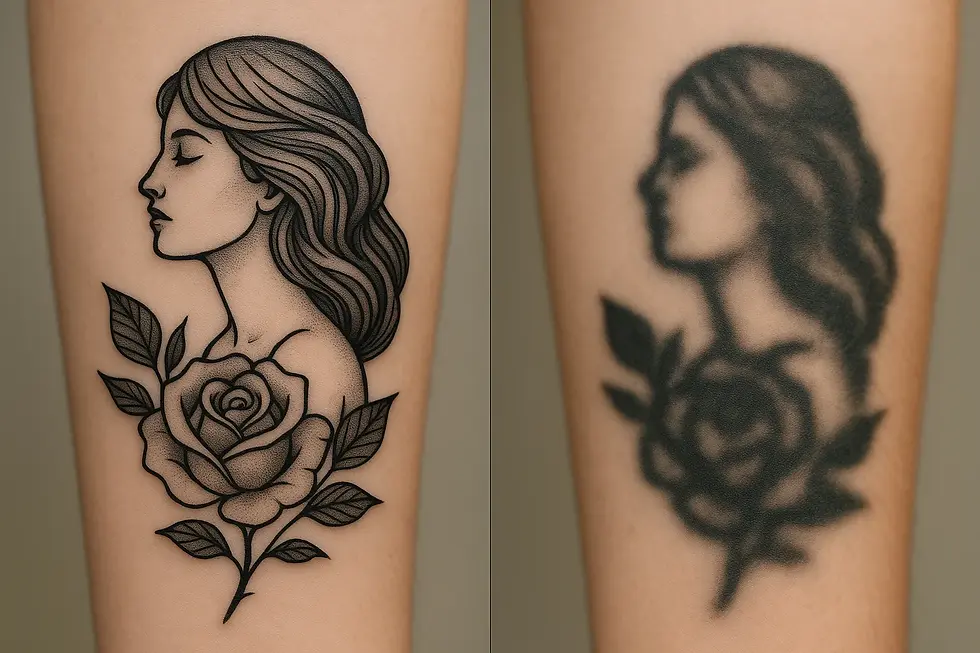
IN THE TRACE OF INK
Tattoo industry

Tattoos and Keloids
What is a keloid, and why does it form?
Keloids are hard, raised scars that grow beyond the edges of the wound after an injury or irritation to the skin ("cuts, pimples, vaccinations, piercings, tattoos, surgical scars"), caused by the body producing excessive collagen.
"The page content is for informational purposes only; for diagnosis and treatment, please consult your doctor."

A keloid is a raised scar that forms as a result of excessive collagen growth during the skin's healing process. These scars extend beyond the original wound and can develop after any type of skin trauma, such as:
Cuts or puncture wounds
Burns or abrasions
Acne lesions
Insect bites
Surgical incisions
Body piercings
Tattoos
Who is most likely to develop keloids?

Keloids are equally common in both women and men. However, individuals with dark pigmented skin are 15 times more likely to develop keloids. People of African, Hispanic, and Asian ethnicities are at the highest risk.
About one-third of people who develop keloids have a first-degree relative who has this type of keloid.
If you have a genetic predisposition to developing keloids, any skin injury that can cause scarring can lead to this formation.
" Keloid" formation at the tattoo site.

Tattoos are a beautiful way to express yourself; however, for some people, tattoos are more than just ink. If you are prone to keloids or thick scarring, you may be wondering if getting a tattoo is safe. Let's look at the complex relationship between keloids, scars, and tattoos, and explore ways to prevent and treat complications.
Early intervention is crucial. If you notice any thickening or swelling of the skin, act immediately:
Apply compression therapy using compression sleeves or garments.
Use silicone gel sheets or patches to reduce the formation of scar tissue.
Seek evaluation and treatment from a dermatologist experienced in treating keloids caused by tattoos.
Is it possible to get a tattoo on or around a keloid?

Yes, but be extremely careful. People with skin prone to keloid formation can still get tattoos, but certain areas are more likely to develop keloids, such as the chest, shoulders, upper back, neck, and ears.

Getting a tattoo over a keloid is possible, but it requires expertise. Scar tattoo.
This technique, known as [technique name], can camouflage scars, but it must be done carefully.
Wait at least a year after a keloid forms before getting a tattoo over it.
Never get a tattoo on an active and growing keloid; it could worsen the condition.
Choose a tattoo artist who is skilled at working with scar tissue. In the wrong hands, tattooing can worsen keloids and cause new scarring.
Tips for Getting a Safer Tattoo:
First, create a small test area using a dot or a thin line.
Stay away from high-risk areas.
Talk to your tattoo artist about your background.
Choose a professional experienced in working with sensitive skin.
What happens if a keloid forms after a tattoo?

Early intervention is crucial. If you notice any thickening or swelling of the skin, act immediately:
Apply compression therapy using compression sleeves or garments.
Use silicone gel sheets or patches to reduce the formation of scar tissue.
Seek evaluation and treatment from a dermatologist experienced in treating keloids caused by tattoos.
How can you prevent keloid formation after tattooing?

If you get a tattoo and want to reduce your risk of keloid formation, here are a few strategies:
Minimize collagen production by avoiding clothing that puts pressure on a healing tattoo.
Protect your tattoo from direct sunlight; UV rays can worsen scarring.
Once healing is complete, apply silicone gel sheets or silicone-based creams to help flatten and fade raised scars.
Keep the area clean and avoid irritation or friction.
Keloid Treatment Options

If a keloid forms on your tattoo and becomes bothersome or aesthetically unappealing, medical treatments may help:
Corticosteroid injections: Reduce inflammation and scar size over time.
Cryotherapy: Uses liquid nitrogen to freeze and shrink scar tissue (best for small keloids).
Laser treatment: Helps to lighten and flatten scarring, and can sometimes affect tattoo ink as well.
Surgical intervention: This is usually done in conjunction with steroid injections or radiation therapy to prevent regrowth.
Radiotherapy: Used to reduce the risk of recurrence after surgery.
Prescription creams like imiquimod (Aldara) can help prevent new keloids from forming after existing ones have been removed.
Important: Keloids frequently recur even after treatment. Combining methods yields the best results. Surgical excision can be combined with steroid injections to provide the best possible chance of preventing recurrence.
Depending on their appearance, you may want to get rid of any keloids you have.
Medical treatments
There are some medical treatments that can help reduce the appearance of keloids, but it's best to consult your doctor before trying them.
Retinoid cream
Retinoid cream is a derivative of vitamin A, or retinol. Similar to natural remedies like garlic or onions, a 2010 study indicated that the cream was clinically effective in reducing the appearance of keloids.
Always follow the instructions on the packaging of the retinoid cream product you purchased.
Silicon
Silicone gel or sheets may be an option your doctor recommends. A 2014 study found silicone gel to be as effective as retinoid cream. Follow the instructions on the silicone product you purchase or the instructions prescribed by your doctor.
Steroid injections
Injections of steroidal anti-inflammatory drugs are known to help with keloids. However, these have been shown to be more effective after major treatments for keloids. As noted in a 2022 review, treatments include surgical scar removal, laser therapy, and more.
A 2021 analysis also showed that combinations of different injected steroids were more successful. However, varying recurrence rates have been reported. Discuss the use of injected steroids in conjunction with surgery, laser scar removal, or other procedures with a doctor.
Methods That Can Be Applied at Home
There are several possible ways to get rid of keloids or minimize them. You can try a few of these home methods first, if approved by a dermatologist for prescription or over-the-counter (OTC) approaches.
Aspirin
A 2020 review and a 2015 study suggest that aspirin may help treat keloids. Research has found that aspirin prevents cells that promote scar formation from entering the keloid area. As a result, both pigmentation and keloid size are reduced. Aspirin can be applied topically at home.
To try this method:
Crush 3 to 4 aspirin tablets.
Mix the tablets with enough water until they form a paste.
Apply the paste to the keloid or scar area.
Leave the paste on for 1 or 2 hours, then rinse it off.
Repeat once a day until the desired results are achieved.
If aspirin paste irritates or burns your skin, discontinue use or reduce application time.
Garlic
According to a 2011 dermatology report, this root vegetable acts like aspirin. Garlic prevents certain enzymes that contribute to tissue and pigment buildup from entering the area. Over time, application can help lighten the color of scars.
To use this method:
Crush 2-3 cloves of fresh garlic.
Apply to the keloid area and leave on for approximately 15 minutes.
Rinse with water and apply moisturizer.
If garlic burns your skin, stop using it or reduce the application time.
Honey
Honey contains anti-inflammatory compounds that may help reduce keloids. Honey was specifically mentioned in a 2020 study for its healing potential in keloids. It is an attractive natural alternative without the potential side effects associated with corticosteroids or nonsteroidal anti-inflammatory drugs (NSAIDs) like aspirin.
For this method:
Apply some raw honey (organic honey is recommended) to the area and leave it on.
If the application area becomes sticky, rinse the honey off afterwards.
Reapply honey as often as needed. It is recommended to use honey at least two to three times a day until you achieve the desired results.
Onion
Many studies support the use of onions in keloid treatment. A 2013 study found that using onion extract prevented fibroblasts, which are cells that produce scar tissue, from entering the skin.
Another study conducted in 2012 found that onion extract gel accelerated healing time and reduced scar height. In a 2011 trial, onion extract gel reduced pigmentation. The gel's effectiveness is most likely due to its content of quercetin, a flavanol with antioxidant properties.
To use this method:
Chop a small onion into small pieces. Red, white, or yellow onions can be used.
Press down with a clean cloth to remove the excess water.
Apply the water to the keloid area and leave it on until it dries.
Rinse and apply three to four times a day until you see the desired results.
Will keloid surgery affect my tattoo?

Yes, depending on the treatment:
Laser treatment can blur or lighten the color of tattoo ink.
If some of the ink is removed along with the scar, the surgical design may need to be changed.
If you plan to have a tattoo treated, be sure to consult both a dermatologist and your tattoo artist.
Can keloids reappear after being surgically removed?
Unfortunately, yes. Keloids are permanent.
Even after surgery, it shows a regrowth rate of up to 100%.
Steroid injections, cryotherapy, or post-surgical radiation therapy can help prevent the disease from recurring.
Combining treatments yields the best long-term results.
Conclusion: Should you get a tattoo if you are prone to keloid formation?

Keloids are not dangerous, but they can affect the appearance of your skin and, in some cases, restrict your mobility. If you are prone to keloid formation, this doesn't automatically mean "no," but you should proceed with caution.
Do your research, talk to experienced professionals, and take preventative steps to protect your skin.
Keloidler, cildin iyileşme sürecinde kontrolsüz bir şekilde aşırı miktarda "fibroblast" hücresi ve kolajen üretmesi sonucu oluşur. Genellikle şu nedenlerle tetiklenir:
-
Cerrahi kesiler ve yara izleri.
-
Sivilce (akne) ve suçiçeği izleri.
-
Piercing, dövme ve kulak deldirme.
-
Yanıklar ve aşı yerleri.
-
Keloid formation occurs due to excessive collagen production. A raised, firm, and sometimes itchy tissue develops that extends beyond the wound boundaries. Keloids are generally harmless. However, they can be aesthetically bothersome and in some cases may cause mild pain or tenderness.
No, keloids don't shrink or disappear on their own. If left untreated, they can continue to grow for years and become permanent.
Evet, keloidler kaşıntılı, hassas veya bazen ağrılı olabilir. Özellikle oluşum sürecinde kaşıntı sık görülür ve giysilere sürtünme ile rahatsızlık verebilir.
Keloid treatment can be challenging and often requires a combination of multiple methods. The most common methods are:
Corticosteroid (Steroid) Injections: These injections are administered into the wound to reduce and flatten the keloid.
Silicone Gel/Dressing: Silicone products applied to the keloid help the scar fade.
Cryotherapy (Freezing Treatment): Freezing small keloids with liquid nitrogen.
Laser Treatment: Used to fade and flatten the keloid.
Surgical intervention: The keloid can be surgically removed, but because of the high risk of recurrence, it is usually combined with radiotherapy or steroids.
Yes, keloids have a very high risk of recurring (recurring) after treatment. They tend to reappear in the same location, especially after complete surgical removal.
Individuals under the age of 30.
People with dark skin (Black, Latino, Asian).
Those with a family history of keloids (genetic predisposition).
Pregnancy and adolescence (due to hormonal changes).
-
Keloids are benign lesions and do not transform into cancerous cells.
-
-
For diagnosis and treatment of keloids, you should consult a Dermatology (Skin Diseases) or Plastic, Reconstructive and Aesthetic Surgery department.
-