IN THE TRACE OF INK
Tattoo industry

What is a Tattoo Blowout, and Why Does it Occur?
And how can it be prevented?

If a grayish halo forms around your tattoo lines and the design becomes blurry 1-2 weeks after getting a tattoo, it's called Tattoo Blowout . This is a permanent problem and will affect the clarity of your tattoo for life. In this guide, we explain what Blowout is, its individual causes, and what you can do to prevent it.

What is a Tattoo Blowout and How Can You Identify It?

Tattoo blowout occurs when tattoo ink penetrates the dermis (the lower layer of the skin) where it should remain , seeping into the underlying fatty tissue and spreading uncontrollably.
Blowout Symptoms:

- A bluish, gray, smoky shadow/halo forms around the fine lines.
- Closely spaced lines merge over time, and details disappear.
- The tattoo looks like it has "burst" or "bleeded".
- It does not disappear even after healing is complete; it is permanent.
Important: Crusting, fading, and slight discoloration seen during days 3-7 of the healing process are normal. You can diagnose a blowout after the tattoo has completely healed, which is typically 3-4 weeks later.
Why does a tattoo blowout occur?
3 Main Reasons
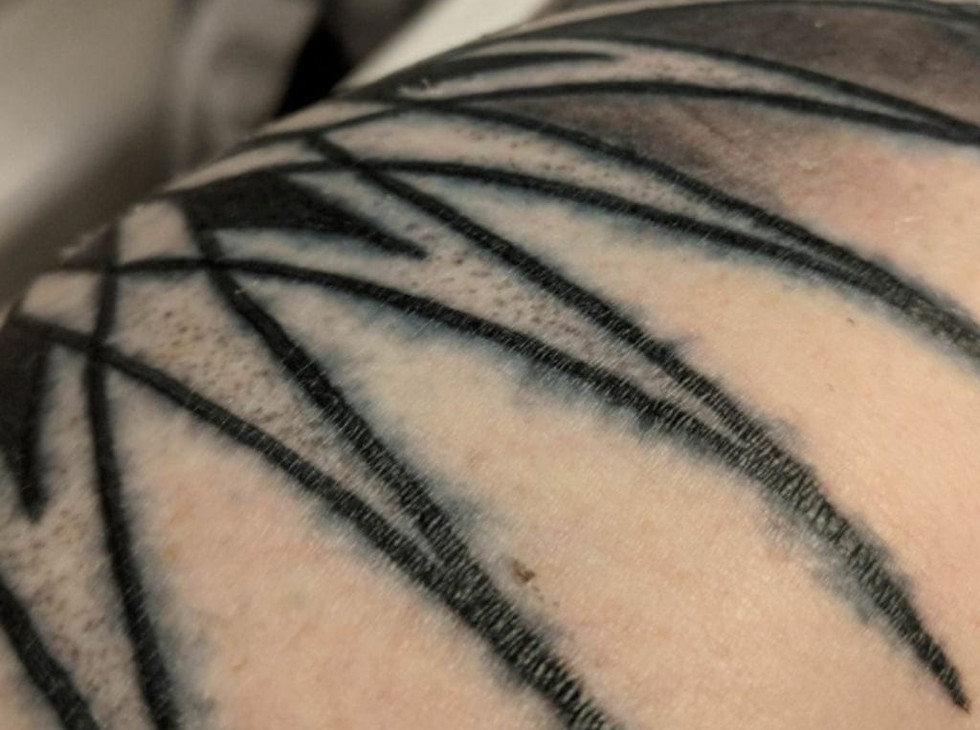
1. Faulty Application Technique - The Most Frequent Cause (80%)
Tattoo ink should be deposited 1-2 mm below the skin's surface, into the dermis. If the artist inserts the needle deeper or holds the machine too horizontally against the skin, the ink will penetrate the lipid layer. Since this layer lacks the fibrous structure to hold the ink, it will spread. This entirely depends on the artist's dexterity, experience, and knowledge of anatomy.
2. Skin Structure and Risk Areas
Not all skin is the same thickness. The thinner the skin, the more difficult it becomes to control the needle, and the lower the margin of error. The areas with the highest risk of blowouts are: fingers, back of hand, inside wrist, top of foot, behind the ear, elbow, and kneecap. Very dry, very old, or excessively elastic skin types are also at risk.
3. Incorrect Healing Process
The first two weeks are critical until the ink has set in the skin. During this period, scratching the tattoo vigorously, picking at scabs, trauma to the area, constant friction from tight clothing, or sleeping on the tattoo can cause the ink, which hasn't yet fully set, to spread.
How to Prevent Tattoo Blowout?
4 Golden Rules

1. Choose the Right Artist: Price Isn't the Only Thing to Negotiate...
A good tattoo artist will analyze your skin type and the area you choose before applying the tattoo. They will adjust the needle depth, machine voltage, and hand speed for each area. When choosing an artist, look for photos of healed tattoos in their portfolio, not just newly done ones. If the lines are still sharp after 6 months, you've come to the right place.
2. Before Your Appointment: Prepare Your Skin for Tattooing
- The 7-Day Rule: For one week before your appointment, moisturize the area where you will get the tattoo morning and evening with a rich, fragrance-free moisturizer. Healthy and supple skin allows for better needle absorption.
- Last 24 Hours: Avoid consuming alcohol, blood thinners (such as aspirin), and excessive caffeine. Blood thinners increase bleeding during the procedure, which can impair the artist's vision and raise the risk of errors.
- Never do this: Tattoos should not be done on sunburned, irritated, or recently cut skin. Postpone your appointment.
3. Choose the region together with your artist.
If your first tattoo is a minimal and linear design, don't take any risks. Areas like the upper arm, shoulder, shoulder blade, upper thigh, and calf are where the skin is most stable and the risk of a blowout is lowest. For finger/hand tattoos, gain experience on your arm first.
4. Follow Recovery Instructions Strictly.
Do not deviate from the maintenance list provided by your artist.
- Prohibited for the first 14 days: Swimming pools, the sea, saunas, Turkish baths, solariums, and strenuous exercise.
- Touch Rule: No scratching, no peeling, no lying on it.
- Hygiene: Use only the recommended antibacterial soap and ointment. Products like petroleum jelly and olive oil clog pores.
Blowout vs. Normal Recovery:
How do I tell the difference?
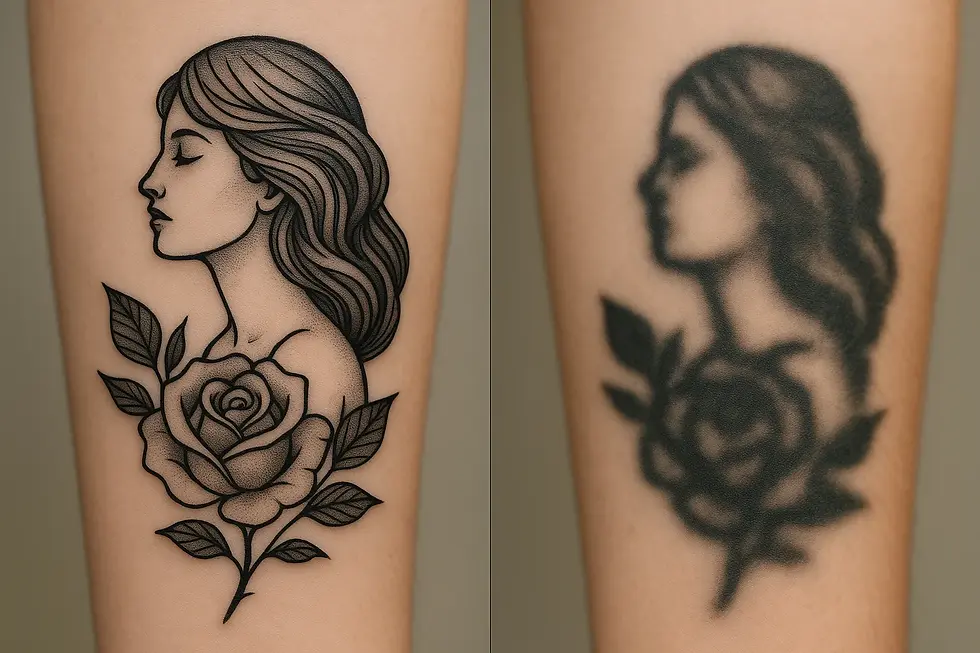
As seen in the image above, normal healing and tattoo blowout (ink spreading) are clearly visible in the tattoos...
The answer to the question "How do I distinguish them?" is:
You can check the table below.

The blowout will not fix itself. You have 3 options for a solution.

1. Laser Removal: By targeting only the diffused area, it can be eliminated in several sessions. This provides the cleanest result but is costly.
2. Correction/Camouflage: An experienced artist can cleverly integrate diffused areas into the design with well-placed shadows or background textures. Ideal for subtle blowouts.
3. Cover-Up: If the spread is very extensive, a new, larger, and darker design is applied over the old tattoo.
Conclusion: The formula for a quality tattoo is clear : 60% The Right Artist + 20% The Right Preparation + 20% The Right Aftercare. If any one of these three is missing, the risk is always with you. Tattooing is a lifelong decision; it's worth the research and the wait.
Evet. Q-Switch veya Pico lazer teknolojileriyle tamamen silmek mümkündür ancak 6-10 seans sürebilir.
Hayır. Bu bir acemilik veya dikkatsizlik hatasıdır. İşinin ehli, anatomiyi bilen sanatçılarda blowout oranı %1’in altındadır.
Yes, but it's much more noticeable in black ink. In colored ink, it's usually perceived as blurring.
No. The ink is trapped under the skin. No cream or oil can remove it. Don't believe such promises.


